Facebook Twitter YouTube Instagram Blog
Sangeet Sadhana is affiliated with "Pracheen Kala Kendra" and "Rabindra Bharati University" Sangeet Sadhana is affiliated with "Pracheen Kala Kendra" and "Rabindra Bharati University"
Home About Us
Learning Experience Orientation Baithak Workshop Projects
Hindustani Vocal Hindustani Instruments Upcoming Events Varshik Mohotsav Tarang Riyaaz – 2015 Subramania Alliance Francaise Gharana Phoenix Market City Registration Blog Contact Us
Hindustani Instrument Classes

Hindustani Instruments (Hindustani Style)

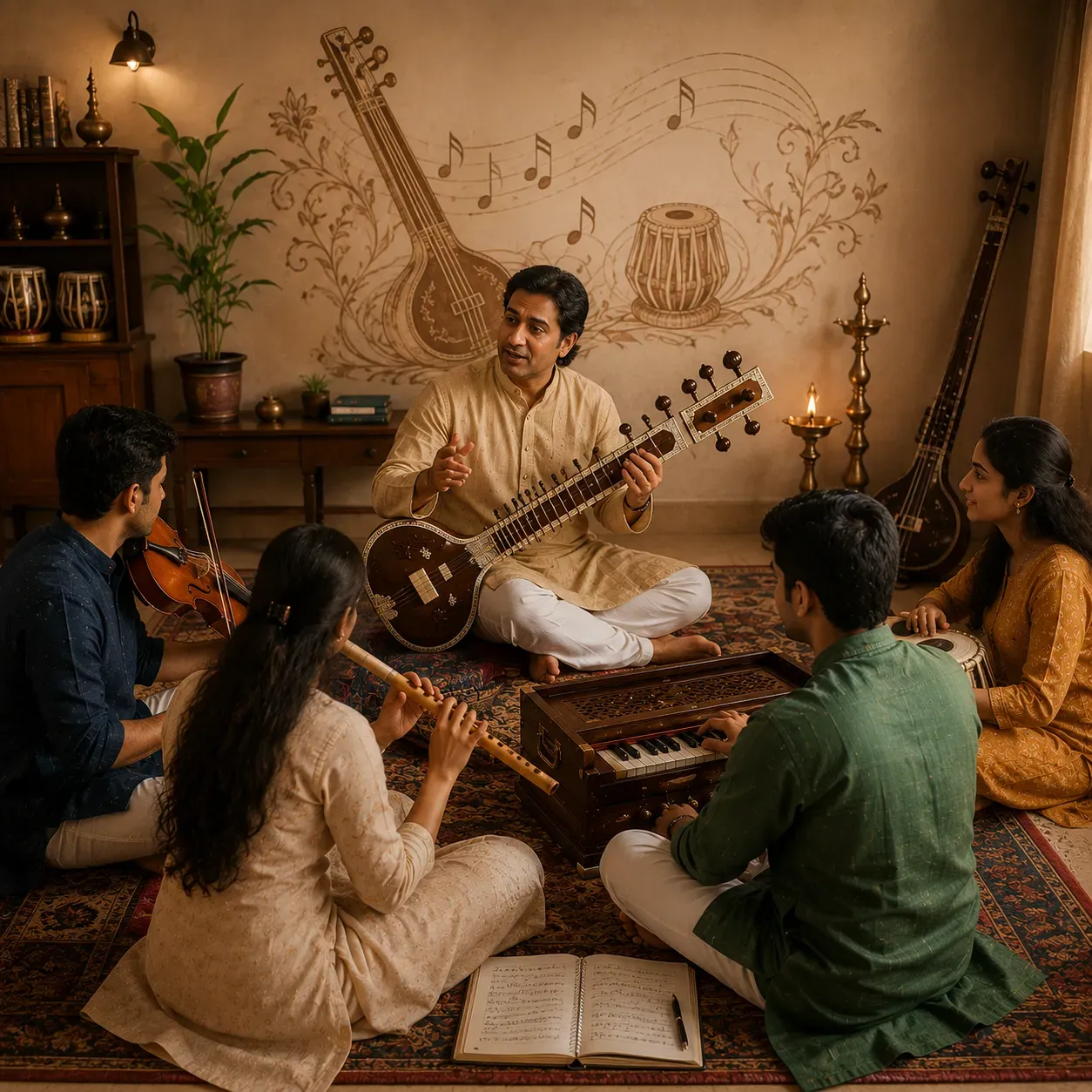
Learn Hindustani instrumental music through traditional techniques, structured practice and detailed demonstrations across string, wind, percussion and harmonium.

Class Duration: 2.5 hrs per session
Frequency: Once a week on Saturdays
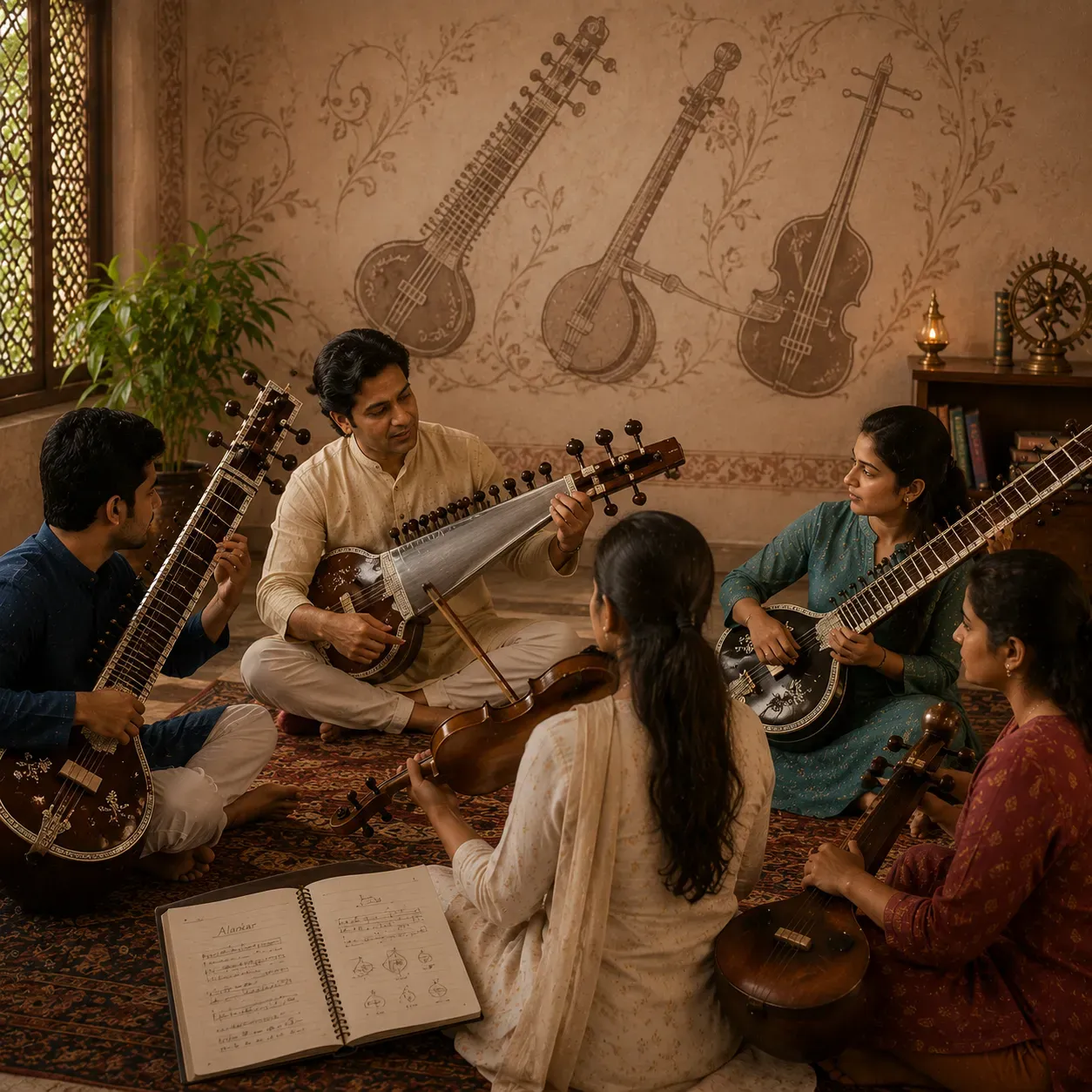
Sarod, Sitar, Violin & Mohan Veena

Methodology Followed

Fingering Techniques of improving or modifying the quality of sound production in order to increase the aesthetic effects are emphasised. Some of these embellishments are kana or grace notes, kampan or tremor, krintan or pizzicato, zamzama, meend or portamento or glissandi, Ladi (quick tremolo strokes) are taught with fine detailing in order to appreciate the subtleties involved in playing Sitar.

Similar ornaments also exist in the case of Sarod but involve slightly different techniques, since the latter does not have frets.

String Instrument Classes

Understanding String Instrument Playing Styles

It is very important to understand the String instrument playing styles that exist.

Mashid Khan Baj (12th Beat Pattern) or Delhi or Pachhwa (Western) Baj

Mashid Khan, a Delhi sitar player, composed several gat-s in various raga-s in which the raga melody was to be played in vilambit teental using fixed mirzab patterns involving both da and ra strokes as well as the combined diri (da + ra) strokes in the same span of time.

These gats were accomplished by toda-s which were extensions of the former, being basically melody lines which expanded on these gat-s and were interspersed with them.

The first line of these gats begins on the 12th beat of the previous avartan. The first line consists of two similar halves and can be regarded as an eight beat pattern, diri da dir da ra da da ra played twice.

There were many improvisations followed post Masit Khan like introducing bin techniques which exhibit the use of meend and zamzama techniques followed by blending elements of Dhrupad with Khayal, by introducing alap in Sitar and Sarod repertoire called jod.

Razakhani Baj or Purab (Eastern) Baj

This style is propagated by Ghulam Raza, a musician at the court of Wajid Ali Shah at Lucknow. The Razakhani gat employs not only the da, ra and dir strokes but also the rda strokes, the opposite of dir where the outward stroke is followed by the inward in quick succession.

Today in contemporary performances we see convergence of different styles. Both the gats are practised using various taals and a high degree of stylizations, which are more systematic and intricate, have been introduced in the original patterns by our guru here in Sangeet Sadhana.

In Sangeet Sadhana Gata (vilambit and drut gat) compositions with Khayal Gayaki Aanga are taught following a particular sequence: Sthayi (Manjh), Antara, Dugun Tan and Jhala with Tan and Tihai. We follow the traditional Aalap-Jod-Jhala-Gat sequence.

Instrumental renditions either follow the Tantkari Ang or the Gayaki Ang. Our String instrument teaching style follows Maihar Gharana (Baba Allaudin Khan Gharana), with considerable vocal influence.

It uses both Khayal Gayaki style and Dhrupad Ang in the rendition. Our Guruji is from Maihar Gharana and usage of all forms of Taans like Chhut and Sapat Tans, Phirat, Diri-Diri Tans and Dhrupad style Gamak Taans are practised here with finer detailing and demonstration.

Wind, Percussion & Harmonium

Wind Instrument

Bansuri (Long Flute)

We use both classical and semi classical style of playing the flute.

Class Duration: 2.5 hrs per session
Frequency: Once a week on Sunday

Methodology Followed

  • Fingering techniques used in playing flute, understanding the texture of the notes and their tonal quality.
  • Techniques to overcome the limitation by changing the scale through transposition or murchhana. This involves making another note Ma or Pa the tonic and thus changing the fingering pattern.
  • How to vary the breadth which is the key to changing the octaves, understanding different blowing techniques to obtain wide musical change and techniques of tonguing and tatkari.
  • The jod and jhal are played by emphasising the rhythmic aspects using a combination of tonguing and blowing techniques.
Percussion Instrument

Tabla

Frequency: Once a week
Duration: 1.5 to 2 hrs per session

Methodology Followed

Understanding the Theka which provides the standard for improvisations including Uthan, Peshkar, Kayada, Rela, Gat, Tihai and Tukda/Chakradhar.

Sound production style, its quality and the techniques used are studied in detail. Rhythmic practices form the core of our teaching methodology.

We follow the traditional Aalap-Jod-Jhala-Gat sequence. Instrumental renditions either follow the Tantrakari Ang or the Gayaki Ang.

Keyboard Instrument

Harmonium Classes

Frequency: Once a week
Duration: 1.5 hrs

Methodology Followed

  • Understanding fingering techniques and playing with ease.
  • Understanding the various scales.
  • Use of Harmonium both as a solo and accompanying mode for a vocalist.
  • Learn compositions specifically meant for Harmonium, styled along the lines of Tantakari, with cut notes and high-speed passages similar to that of a string being plucked.
  • Developing greater physical command over the instrument by playing difficult note patterns at speed and bringing in the vocal or Gayaki Aang form.

Hindustani Instrument Learning Levels

Progress from learning instrument handling and foundational techniques to advanced performance, musical interpretation and individual artistic expression.

6 Months

Basic Level

  • Handling instrument and sitting posture.
  • Fingering techniques and hand movement.
  • Improving or modifying the quality of sound production.
  • Practice of Moorchana, Sapat and Paltas.
  • Classification of different music instruments.
2.5 Years

Intermediate Level

  • Use of embellishments like Kana or grace notes, Kampan or tremor, Krintan or pizzicato, Zamzama, Meend or portamento or glissandi and Ladi (quick tremolo strokes) taught with fine detailing.
  • Introduction to the various playing styles.
  • Playing various Vilambit and Drut compositions of Ragas and understanding the Gats and techniques associated.
  • Understanding the instrumental renditions of mastered musicians which helps in acquiring musical craftsmanship of high order.
5 Years

Advanced Level

  • Gaining mastery over the instrument, and understanding and rendering compositions modified to suit the artistic capability of the individual.
  • Convergence of styles in contemporary performances.

Musical Classes in Bangalore: Reviews & Testimonials

"I have started my music classes in sangeet sadhana 6 months back, Great place to learn classical Hindustani music. Sangeet Sadhana follows guru sishya parampara which helps each student to lean with focus and in a traditional way. Perfect place and perfect environment for practice. Teachers over here are awsome they take care by attention to individual."

S
Sri ChaitanyaBangalore

"I have been part of Sangeet sadhana for more than 1.5 years. I am glad to be part of a school which is not only teaching students music and art but also nurturing them to be humble in life. Concept of guru shishya parampara which is followed in the school helps you in connecting to music in profound way."

R
Reetika MalhotraBangalore

"If you are looking for an authentic place to learn Hindustani classical music this is the place to look forward. I thoroughly enjoyed the way they taught & the attention they gave. You can actually feel the guru shishya parampara followed here unlike lot of places which are in the business of music."

S
Santosh JagtapBangalore

"I joined Sangeet Sadhana 4 months back for Hindustani Classical music. Its really helping me to explore music. Classes are well arranged with detailed Notes and Individual focus. If you want to learn Hindustani Classical music from scratch Sangeet Sadhana is the place for you."

N
Nitish HardeniyaBangalore

"Awesome place to learn Music!!! Anindita mam and Ritesh Sir are outstanding teachers. Definitely worth learning if you want to learn music."

A
Ajay Partap Singh ChhokarBangalore

Get in Touch

Address:
#720, 9th main, 4th Block, Koramangala, Bangalore - 560034
Landmark: Sony World Signal

Ms Anindita Mukherjee (Guru/Founder):
+919900251018

Ms Swathi:
+919686950505

sangeetsadhana09@gmail.com

Send us a Message

📞 Call Back

Call Back